FAQS
Here you can find a selection of commonly asked questions about paragliding and our training programs. If you have a good question that is not answered here, let us know, as your question could provide the answer that others might be looking for! 🙂
We are enthusiastic about taking pilots age 14 and over under our wing, though participants under the age of 18 must have a parent or legal guardian sign the consent form and participants age 15 and under must have active parental participation in their training and/or flying adventures.
Additionally, there is a 225# max weight requirement (up to #240 – Height/weight proportionate).
People with pre-existing conditions such as unstable bone/tissue injuries, pregnancy, or other conditions should refrain from participating.
If you have any questions, or special needs, please reach out. We will do our very best to get you into the air!
Yes! The only requirement is that it must be secured to your person to prevent it falling in flight. Cell phone camera use is not allowed for this reason. (Dropping things into someone’s picnic is a definite no-no!)
We do offer in flight HD video as an option to all our tandem programs. (Ask for details.)
“I can’t fly in a paraglider, because of my fear of heights!!!”
Not surprisingly, we hear that quite often. Really. Very often. Don’t feel at all alone if you have this fear, or perceived fear as the case may be. If you have found your way to this page, you obviously have some dreams of flight, and believe it or not, it’s probably a lot more possible than you think.
Consider this: In our ongoing survey, at least 95% of the people that feel they have a fear of heights, are actually afraid of ‘edges’, or more specifically, from falling off of them. Have you ever flown on an airplane? Did you have a window, or an aisle seat? If you sat by the window, did you look down and enjoy the view? From 30,000′ or more high?!? So really, do you have a fear of heights? Paragliding is quite like that. You feel you are one with the sky, and the fear of the dreaded ‘edge’, or of falling from it, rapidly ‘falls away’ as you experience your first flights.
On the other hand, are you the type that would sit in the aisle of the airplane, shades drawn, never glancing the great view of the mountains below? Don’t worry, there is paragliding hope for you too! There is an entire branch of paragliding that is excellent fun, great exercise, and never gets you much higher than 30′ or so over the ground. (Lower if you like.) One of our favorite former students (now good friend) falls into this category. He doesn’t like heights at all, but dune skimming is what he excels at. Find him at Cape Kiwanda, or at Area B almost any day it’s soarable. Great fun, while still allowing you to experience flying as you have probably dreamed. Some of the best fun in paragliding comes from giving the kids, (and adults), a high five as you fly by them as they cheer you on! Seriously good fun!
One of the best ways to get an introduction to Paragliding is through our Introductory Tandem Experience package. Or, if you would prefer a solo introduction, you have the option of signing up for a One or a Two Day Introductory Course. Or, if you are already convinced that paragliding is for you, you can also sign up for either of our full Beginner or Novice Programs.
Either way, you have already completed the second hardest part in beginning your journey into the paragliding world. You have found us! Certainly, the most difficult part is just ahead of you right now, and that’s making a decision. Are you content with just looking at our website imagining what it would be like to be ‘up there too’, or are you ready to take that ‘hardest’ step towards joining us in the air?!? …All it takes is a phone call or an email to get you on the schedule. Go on, you know you want to! 🙂
To sign up or just to find out a bit more about any of our programs, simply contact us, either via our contact form, e-mail, or telephone, and we’ll take it from there. We are always happy to answer any questions you might have, and when you’re ready, we’ll schedule your adventure at a time that’s convenient for you.
Short flights off the beginner hill or via our towing system usually occur by the end of the first (or second) day with any of our solo training programs. To become educated enough to make your own flight decisions normally takes between 9 to 14 days of instruction. Afterwards you can become certified with the United States Hang Gliding and Paragliding Association, (USHGA), as a Novice rated pilot. The Novice, or Para – 2, rating indicates that you have met the minimum requirements for solo flight. We at Discover Paragliding! recommend a minimum of 10 days of instruction, with our preferred average being closer to 15 days.
Any activity has inherent risk. Paragliding, as with any type of aviation or adventure sport, is no exception.
With the proper education and a healthy awareness of your own personal motivations and attitudes, risk can be a minimal part of your flying experience. We have found that the single most important variable in pilot safety is the pilot himself. We spend a great deal of time educating our students how to evaluate their own skills, their attitudes, motivations, and awareness levels before each and every flight. With the ability to objectively evaluate one’s own “attitude and aptitude”, (which vary with each day), and when appropriate, being able to say to yourself “I don’t feel up to the task today, so I’m not going to fly,” then paragliding can be one of the most rewarding things you can experience in life. Having an unwavering respect for the sport and embracing continuing education, can make all the difference between a good pilot and a dangerous one.
We do require an appointment for all of our classes/flights, since our exact location changes at the whim of the winds. We also prefer as much notice as possible, but that said, never give up as we may have an open slot coming up right now!
You can contact us either by phone, (503-440-0733), or you can go to our sign UP! form here:
We request that all students check in for a weather evaluation the evening before, and oftentimes the morning of your session prior to your home departure. We would prefer to not have you drive out to the coast to sit in the rain at least as much as you would! That said, we do have a lot of experience with the weather out here, and often schedule flights on days that might otherwise seem impossible for a vantage point that’s an hour or more away.
We may also make adjustments to meeting times to allow for optimal weather windows during the day. But basically, when we are choosing the conditions to fly, the safety of all involved is paramount and we will make our decisions accordingly.
If the weather proves unfavorable and we have to cancel as a result, we are happy to reschedule at your convenience, or if necessary issue a full refund.
Our Introductory Tandem Experience package is suitable for almost anyone wishing to experience flight, though we do have a max weight restriction of 240 pounds for a height/weight proportionate person.
For launch, you will need to be able to run a few steps as you become airborne. When you come in for landing, you need to be confident that you can stay on your feet and be able to absorb an ‘impact’ comparable to skipping the last step on a flight of stairs.
We are always happy to fly most anyone, regardless of physical ability although. Please contact us and discuss your special circumstances and we will do what we can to make the proper arrangements. With proper weather conditions and advanced notice, there are few things we enjoy more than sharing our passion with someone to might previously have thought it impossible.
For our solo programs, be aware that handling a paraglider is about finesse, not about strength. You should be in reasonable physical shape, be able to run short distances, and be able to hike up our training hills while carrying about 25 pounds of gear. Fortunately, with any of our towing programs, there is no need to hike up the training hill at all for those first flights.
Our school gliders are able certified for a pilot weight range up to 250 pounds, but we can work with folks of larger proportion by special arrangement.
Paragliding is an aviation sport that can open the window to a whole new world of life experiences. Paragliding adventures can range from simply driving to the top of your favorite local launch for the afternoon, to trekking to some of the most remote locations in the world.
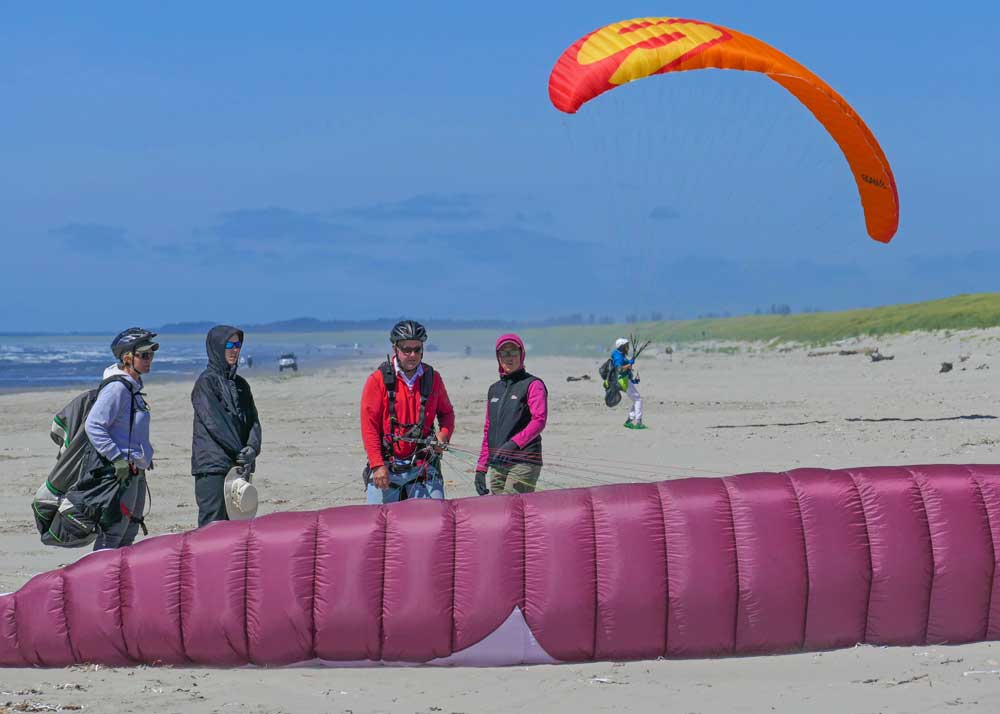
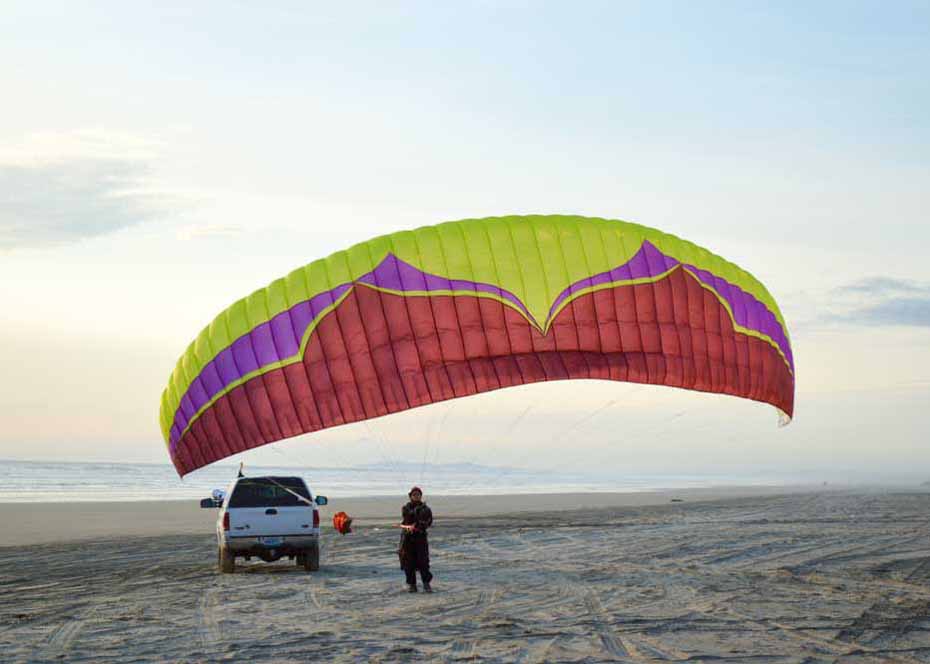
Although they somewhat resemble rectangular skydiving parachutes, (from which modern paragliding has evolved), paragliders are now designed to keep you aloft for extended flights, soaring, climbing and sinking with the currents of the air. You can launch your paraglider from shallow slopes or on steep hills. It’s a simple matter to unpack the wing, clip in, inflate the wing overhead, and then with a few running steps, become airborne.
A paraglider is small enough to be stowed in an oversized backpack and light enough to carry on your shoulders. It’s so portable you can take it almost anywhere.
With the steering toggles (brakes), you can easily control the direction of flight. After gaining some experience, you can begin to use the upward movement of the air, (thermal or ridge lift), to stay aloft for hours. When it’s time to come down, landing can be just as simple. One of our more popular “fly-in” contests is the “spot-landing,” where the object is to land on a silver dollar.
With the proper training, you can become a well-educated, safety-conscious pilot capable of choosing flights ranging from peaceful and serene, to extended thermal climbs and cross-country experiences.
Powered Paragliding is a close cousin to paragliding, and makes a great companion to the sport, or even an exciting sport in it’s own right. Flying can be done with either your existing paraglider wing, or a more specialized PPG wing. Add the powered paraglider unit under that, and you have one of the most convenient methods of personal aviation available today.
Just as with paragliding, Powered Paragliding (PPG) has many different ‘styles’. Popping out to the local field and going for an hour flight around the local area is probably the most common type of flight, while other options include long distance flying, or even aerobatic flight as well!
While they look the very similar, Powered Paragliding and Paragliding are actually two fairly different ways to enjoy flying. With PPG, you have the ability to fly unconstrained by the shape of the terrain, or by the drift in a thermal. You can do a lot of exploring of ‘uncharted’ territory with a PPG, that is often not available with a PG. We are equally enthusiastic about both PG and PPG, and consider it part of our job to help you decide which sport (if not both!) is right for you!
For our training locations in the Pacific Northwest:
We have a fairly liberal cancellation policy, but we would appreciate at least 48 hours advance notice to allow time to schedule others to take your place. Within 24 hours there will be a 50% cancellation fee.
Groups of 4 or more require 72 hours advance notice for a full refund, and we reserve the right to charge a 50% cancellation fee with less than 48 hours notice.
There are no refunds for no-shows, late arrivals, or early departures unless prior arrangement has been made.
For our International Tours/Travel:
Do to the complications of planning longer trips, our cancellation policy is as follows:
For international travels, we strongly recommend that you purchase a Travel Insurance package. There are several companies to choose from, and we recommend that you do some research and make sure you are getting a policy that covers Paragliding and related activities.
We have used both www.WorldNomads.com and www.Travelguard.com, but there are many other options available.
If the unforeseen occurs, and you do have to cancel your trip with us, we have the following policy:
Cancellations more than 120 days prior to tour start date are allowed a full refund.
Cancellations less than 120 days prior to tour start date will be refunded 50% of tour cost, unless your spot can be filled by another individual.
Cancellations less than 90 days prior to tour start date are non-refundable, unless your spot can be filled by another individual.